Purisai Therukoothu
Purisai Therukoothu: Performance, Costume, and Living Memory
Therukoothu is a traditional Tamil theatre form that brings together performance, storytelling, costume, music, and community. Practised for centuries in Tamil Nadu, it is not confined to a stage; it exists in open spaces, village grounds, and temple contexts, where the boundary between performer and audience dissolves.
In its essence, Therukoothu is not only a performance tradition. It is a cultural system where narrative, costume, and embodiment come together to carry memory across generations.
The form can be experienced through performances such as:
Panchali Sabadham, performed by the Purisai Therukoothu lineage
Origins: From Koothu Traditions to Therukoothu
The word Koothu in Tamil broadly refers to performance traditions that combine movement, storytelling, and music. References to such performative practices can be traced back to early Tamil literature.
In the Tolkāppiyam, one of the oldest extant works of Tamil literature, there are references to performance, expression, and the relationship between the body, emotion, and narrative.
Similarly, the Thirukkural reflects a cultural world where performance and storytelling were part of everyday life, shaping moral, social, and philosophical discourse.
Over time, these early forms evolved into distinct performance traditions.
One such form is Tholpavai Koothu, a shadow puppetry practice where epics are narrated through leather puppets and light. While structurally different, it shares with Therukoothu a deep engagement with epic storytelling, rhythm, and community gathering.
Therukoothu emerges within this larger continuum: moving from shadow and narration into fully embodied performance, where the human body becomes the primary medium of storytelling.
A Living Tradition from Purisai, Tamil Nadu, India

Among the many lineages that continue this practice, the Purisai tradition remains one of the most respected.
Rooted in Purisai village in Tamil Nadu, India, this lineage has preserved Therukoothu through rigorous training, performance discipline, and intergenerational knowledge transfer. The practice is sustained not through institutions, but through lived experience, where learning happens through observation, repetition, and immersion.
The performers do not simply act. They inhabit characters drawn from epics such as the Mahabharata, transforming through costume, voice, and movement.
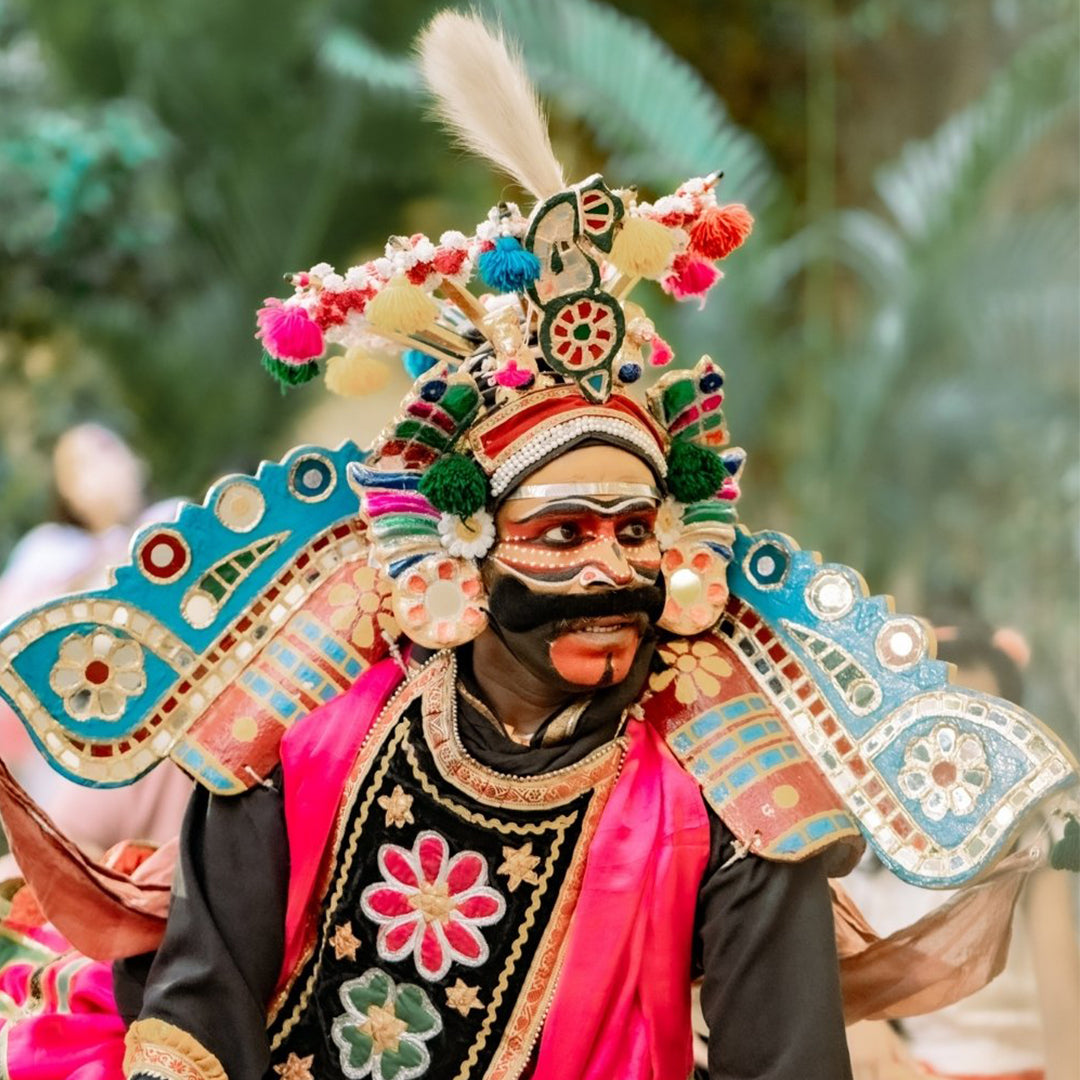
The make-up, the headgear, the layered costumes, each element carries meaning. Nothing is ornamental. Everything is functional, symbolic, and deeply embedded in the performance's grammar.
Costume as Structure, Not Decoration
In Therukoothu, costume is not designed as fashion.
It is constructed as an extension of the body, amplifying gesture, presence, and narrative. The scale, colour, and materiality are all calibrated to perform in open-air settings, often through the night, under minimal lighting.
This relationship between body, costume, and performance became a point of engagement for the studio.
Rather than interpreting Therukoothu as a visual reference, the approach was to understand:
- How costume behaves in motion
- How structure supports performance
- How identity is built through layers
Working with the Purisai Therukoothu Lineage

The engagement with the Purisai lineage was not extractive or interpretive. It was built through direct interaction, observation, and collaboration with artists and practitioners.
This included:
- time spent understanding performance preparation
- documentation of costume and make-up processes
- conversations with senior artists, including Purisai Kannappa Sambandhan and performers from the lineage
The objective was not to "translate" Therukoothu into fashion, but to create a dialogue between two systems of making.
Therukoothu From Purisai Village Grounds to London Fashion Week

In 2023, this dialogue extended to the global stage.
Therukoothu was presented at London Fashion Week as part of the Purisai collection by Vino Supraja. This was not a symbolic reference or a stylised adaptation; it was a live performance by artists from the Purisai lineage, presented within the context of a contemporary fashion platform.
The intention was clear:
not to aestheticise the tradition,
but to reposition it within a global cultural conversation.
For many in the audience, this was their first encounter with Therukoothu: not as documentation, but as a living, embodied performance.
The Purisai Collection: Couture Through Cultural Systems

The Purisai collection emerged from this engagement.
Purisai presentation at London Fashion Week, 2023 - Video
Rather than replicating costume, the work explored:
- structural layering
- volumetric silhouettes
- movement-oriented construction
The garments were developed as contemporary couture, informed by the logic of performance rather than surface aesthetics.
This positioned the work within a broader context of:
- craft-led fashion
- heritage-based design systems
- sustainable and ethical fashion rooted in knowledge traditions
Therukoothu and Contemporary Fashion
Therukoothu exists outside the cycles of trend and season.
Its continuity comes from:
- repetition
- discipline
- community
- time
In contrast, contemporary fashion operates on an accelerated pace.
The intersection between the two raises important questions:
What does it mean to bring a living tradition into a global fashion system?
How can this be done without reducing it to visual language?
What is the role of designers working with such traditions today?
These questions continue to shape the studio's work.
Purisai Therukoothu Video Documentation
As part of ongoing documentation, the studio has recorded conversations, performances, and short-form observations around Therukoothu and the Purisai lineage.
You can explore these here:
- LFW Therukoothu performance BTS excerpts
- Conversation with Padmashri Purisai Kannappa Sambandhan Ayya
- Costume and preparation processes
- Paanjali Sabadham - Purisai Therukoothu
A Continuing Association
The relationship with the Purisai Therukoothu lineage continues beyond a single collection or presentation.
It is part of a longer engagement with:
- performance traditions
- cultural memory
- systems of making
Choreography developed for
Weave: A Bhavani Tribute, London Fashion Week 2025, by Purisai Palani Murugan
About the Studio
Vino Supraja is a Dubai-based craft-led, sustainable, and ethical fashion designer known for couture and red-carpet work rooted in heritage textiles. The studio works at the intersection of craft, culture, and contemporary fashion, developing limited works through direct engagement with artisan communities and cultural practitioners.
The studio’s work also engages with textile traditions such as Bhavani Jamakkalam.